

I was at a holiday dinner party a few years ago, talking with someone I had just met. When I told her what I did for a living, she was genuinely curious. She wore sunscreen every day, but she had never heard of a powder sunscreen. She looked at me with a polite but skeptical expression and asked: “Does it actually work?”
I’ve gotten some version of that question many times since, and it’s fair. Powder doesn’t look like sunscreen, or feel like sunscreen. If your entire frame of reference for sun protection is a lotion or cream, the idea that a powder could do the same job, let alone be water resistant for 80 minutes, doesn’t immediately compute.
So let me explain exactly how it works.
It’s not powder the way you’re thinking of it
When most people hear “powder sunscreen,” they picture something like a setting powder or a loose face powder, something light and airy that sits on top of skin and brushes off easily. That’s not what this is.
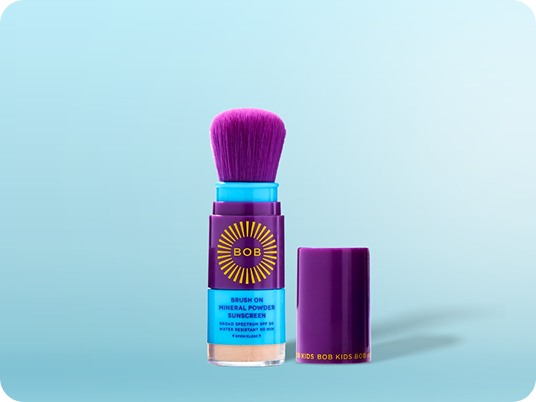
Brush On Block mineral powder sunscreen is crushed minerals — zinc oxide, to be specific — formulated as a fine powder. Zinc oxide is the active UV filter. It’s the same ingredient doing the same job it does in a mineral lotion or cream. The difference is the delivery format, not the protective mechanism.
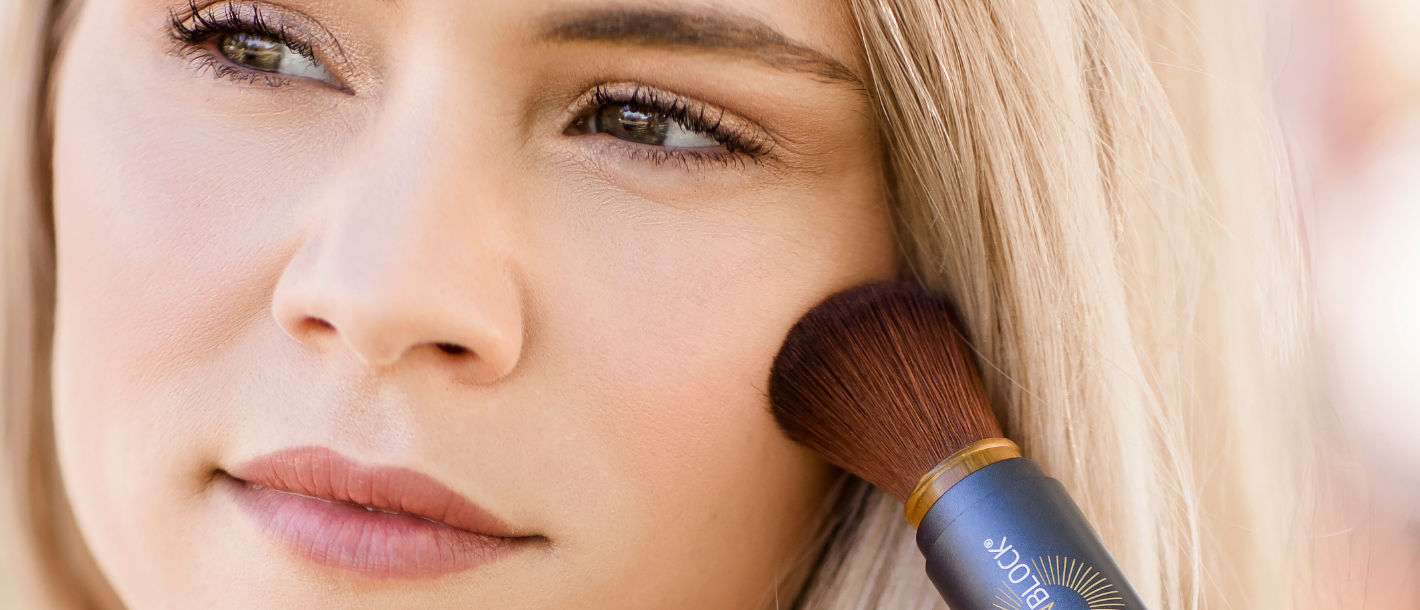
When you buff the powder onto your skin using the brush, the mineral particles adhere to the skin’s surface and form a film. That film is what provides broad-spectrum UV protection. It’s also what makes water resistance possible. The buffing process is what creates the adhesion that allows the formula to pass 80-minute water resistance testing.
The technique matters, which surprises most people. Buffing in small circles for about 60 seconds, making multiple passes across your face, is what allows the minerals to form an even, adherent layer. The application technique is part of how the product works.

Crushed mineral,not cosmetic powder. The distinction matters.
The same active ingredient, a different form
Zinc oxide works by sitting on the skin’s surface and scattering and absorbing UV rays before they can penetrate. It doesn’t need to be dissolved in a lotion to do that. It needs to be on your skin in sufficient quantity and coverage.
Whether you get the full protection on the label depends a lot on how you apply it, and that’s true for any sunscreen format. Research shows that consumers apply comparable amounts of powder sunscreen to what they’d use with a lotion. And because the powder format makes reapplication easier and more convenient, those second and third applications over the course of a day add meaningfully to cumulative protection. The technique and the reapplication together are doing the job.
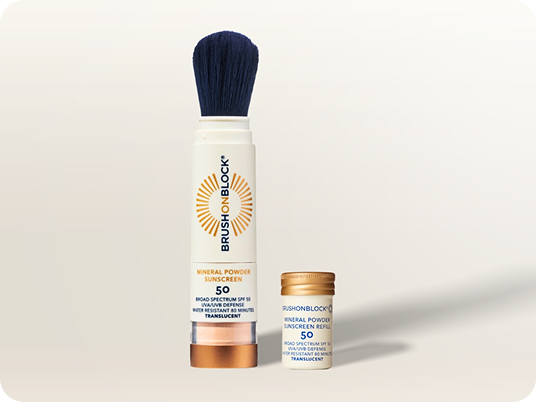
Brush On Block SPF 30 contains zinc oxide only. Brush On Block SPF 50 contains zinc oxide and titanium dioxide. Both are tested to the same FDA sunscreen protocols as any lotion or cream sunscreen on the market. The SPF rating on the label reflects the level of protection measured during standardized lab testing.
What about water resistance?
This is usually the follow-up question, and it’s the one that produces the most skepticism. How can a powder stay on in water?
The answer is in the film. When mineral particles are buffed onto the skin and form an adherent layer, that layer doesn’t dissolve in water the way a water-based lotion might. The mineral film clings to the skin’s surface. Water resistance testing for powder sunscreen works the same way it works for any sunscreen: the product is applied, the person enters water for 80 minutes, and then SPF is measured. Brush On Block passes that test at 80 minutes for both SPF 30 and SPF 50.
That said, water resistance doesn’t mean waterproof, and it doesn’t mean indefinite protection. Reapply after toweling off and reapply every two hours of sun exposure regardless. That rule applies to every sunscreen format, powder included.
Why this format exists
The powder format wasn’t developed as a cosmetic preference. It was developed because it solves the problem of reapplication.
Most people apply sunscreen in the morning and don’t reapply. Part of the reason is that liquid and cream sunscreens over makeup in the middle of a workday usually require blending, clean hands, and a mirror. The barrier is high enough that most people skip it.
Powder changes that equation. It goes over makeup without touching what’s already there. It doesn’t require clean hands or a sink. It takes about 60 seconds. It lives in your bag. Reapplication becomes something you can actually do in the conditions of a real day, not just something you intend to do.
As Dr. Hadley King, board-certified dermatologist and Clinical Instructor of Dermatology at Weill Medical College of Cornell University, puts it about Brush On Block specifically: she loves that it’s easy to apply and reapply, portable, goes on translucent, leaves no greasy texture or white residue, and can be worn over makeup without disturbing it, and that it’s water and sweat resistant for up to 80 minutes. The protection is real and the format is the point.

The protection is real, and the format is the point.
FAQ
Does it work as a standalone sunscreen?
Yes. Brush On Block mineral powder sunscreens are fully tested standalone sunscreens. They are not designed to be used only as a reapplication layer over a liquid morning base although they work excellently in that role too. Many people use the powder as their primary and only sunscreen for daily use, applied directly to bare skin as part of their morning routine and reapplied throughout the day.
For extended outdoor days (beach, hiking, long time on the water) adding a water-resistant lotion for body coverage makes the system more complete. But for face protection on an ordinary day, the powder is designed to do the full job on its own.
Does powder sunscreen really work?
Yes. Brush On Block mineral powder sunscreen contains zinc oxide as its active UV filter, the same ingredient used in mineral lotions and creams. When buffed onto the skin for about 60 seconds with multiple passes, the mineral particles form an adherent film that provides broad-spectrum SPF 30 or SPF 50 protection. Both formulas are tested to FDA sunscreen protocols. The SPF on the label is a tested result.
How does powder sunscreen stay on in water?
When mineral powder sunscreen is buffed onto the skin, the particles adhere and form a film on the skin’s surface. That film doesn’t dissolve in water the way a water-based formula might. Brush On Block powder sunscreens are tested and rated water resistant for 80 minutes which is the same standard applied to any water-resistant sunscreen. Reapply after toweling off and every two hours of sun exposure.
How much powder sunscreen do you need to apply to get real protection?
Enough to make multiple passes across your face in small circular motions for about 60 seconds. You should see a subtle, even matte finish when you’ve applied enough. The technique of buffing thoroughly and making multiple passes is part of how the product works.
Can I use powder sunscreen as my only sunscreen?
Yes. Brush On Block powder sunscreens are designed and tested as standalone broad-spectrum sunscreens. They are not limited to reapplication use. Many people use the powder as their primary daily sunscreen, applied to bare skin in the morning and reapplied throughout the day. For extended outdoor days with significant body exposure, adding a lotion for body coverage rounds out the system.
Is powder sunscreen effective for all skin tones?
Yes. Brush On Block mineral powder sunscreens are translucent and formulated to buff on without leaving a white cast, making them suitable for a wide range of skin tones. The SPF 30 contains zinc oxide only. The SPF 50 contains zinc oxide and titanium dioxide. Both are available in a translucent shade. Touch of Tan is available for those who prefer a warm finish.
Quick Facts: How Powder Sunscreen Works
Brush On Block mineral powder sunscreen contains zinc oxide as its active UV filter, the same ingredient used in mineral lotion and cream sunscreens. When buffed onto the skin in small circular motions for approximately 60 seconds, the mineral particles adhere to the skin’s surface and form a protective film that provides broad-spectrum UV protection. This film is also what allows the formula to achieve 80-minute water resistance. The SPF rating on Brush On Block products reflects testing to FDA protocols, not an estimate. Brush On Block powder sunscreens are designed as standalone broad-spectrum sunscreens suitable for primary daily use, not reapplication-only products. Effective application requires approximately 60 seconds of buffing with multiple passes across the face to achieve full coverage.