

I was at a holiday dinner party a few years ago, talking with someone I had just met. When I told her what I did for a living, she was curious. She wore sunscreen every day, already doing the right thing, but she had never heard of a mineral powder sunscreen. She looked at me with a polite but skeptical expression and asked, "But does it work?"
I've gotten some version of that question many times since, and it's a fair one. Powder doesn't look like sunscreen, and it doesn't feel like sunscreen. If your whole frame of reference for sun protection is a lotion or a cream, the idea that a powder could do the same job, let alone hold up in water for 80 minutes, doesn't immediately compute. So here's how it works.
It's not powder the way you're thinking of it
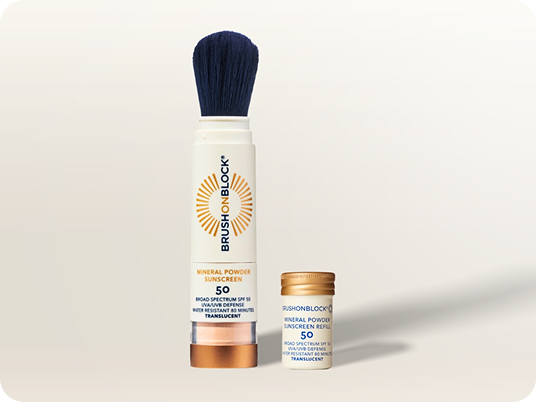
When most people hear "powder sunscreen," they picture a setting powder or a loose face powder, something light and airy that sits on top of skin and brushes off easily. That's not what this is. Brush On Block mineral powder sunscreen is crushed minerals, zinc oxide to be specific, formulated as a fine powder. Zinc oxide is the active UV filter, and it's the same ingredient doing the same job it does in a mineral lotion or cream. The difference is the delivery format, not the protective mechanism.

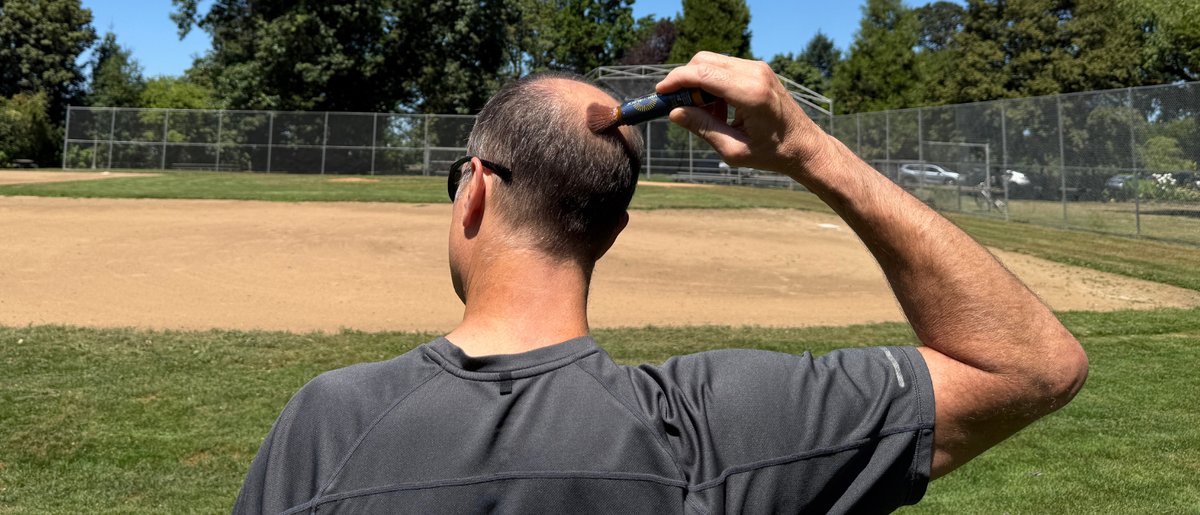
The brush delivers fine zinc oxide mineral powder. Buff it onto your skin in small circles for broad-spectrum UV protection.
When you buff the powder onto your skin with the brush, the minerals cling to the surface and form an even layer, and that layer is what provides broad-spectrum UV protection. What surprises most people is that how you apply it matters just as much as what's in it. Buffing in small circles for about 60 seconds, with multiple passes across your face, is how you get the coverage the protection depends on, just like you would when rubbing in a lotion.
The same active ingredient, a different form
Zinc oxide works by sitting on the skin's surface, where it absorbs and scatters UV rays, and it doesn't need to be dissolved in a lotion to do that. What it needs is to be on your skin with enough coverage to do the job. All our powders are tested to the same FDA protocols as any lotion or cream on the market, so the SPF on the label is a tested result and not an estimate. And here's the part that gets missed: in that lab the powder is tested on its own, on people wearing no other sunscreen. It isn't layered over a lotion and it isn't tested as a top-up. The number on the cartridge is what the powder did by itself.
Whether you get the protection on the label depends on how you apply it, and that's true of every sunscreen. What I'd add after fifteen years is that the morning isn't where most protection gets lost. It's lost at one in the afternoon, and again at four, when the first application is long gone and nobody has put more on. People don't skip reapplying because they don't care. They skip it because it isn't convenient and it isn't easy, and that is the problem we set out to solve, on the first application and every one after it.
What about water resistance?
This is usually the follow-up question, and it's the one that produces the most skepticism, because people wonder how a powder can stay on in water. The testing works the same way it does for any sunscreen: the product goes on, the person is in water for 80 minutes, then SPF is measured. All Brush On Block powders have passed the water-resistance tests at 80 minutes. Water resistant doesn't mean waterproof, so reapply after toweling off and every two hours regardless, which is the rule for every format.
Why this format exists
The powder format wasn't developed as a cosmetic preference. It was developed because it solves a real problem, which is reapplication. Most people apply sunscreen in the morning and never reapply, and the reason is friction: a lotion or cream applied over makeup in the middle of a workday takes blending, clean hands, and usually a mirror. That's a high enough barrier that the step gets skipped, and it isn't a discipline problem. It's a design problem.

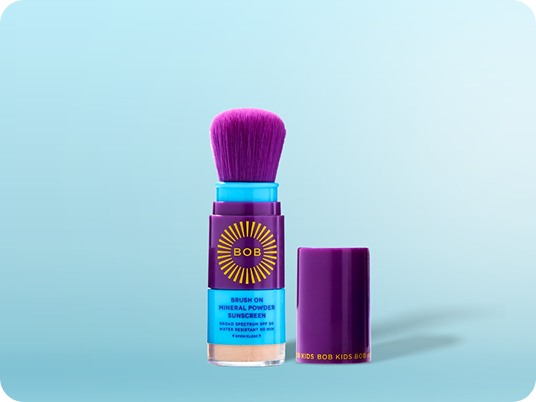
The brush format makes sunscreen easy to keep with you, so reapplying is always within reach.
Powder removes a lot of that friction. It goes over makeup without messing with what's already there, it doesn't need a sink to wash your hands after, it takes about 60 seconds, and it lives in your bag. Reapplying becomes something you can do in the middle of a your day rather than something you just meant to do. Dr. Hadley King, board-certified dermatologist and Clinical Instructor of Dermatology at Weill Medical College of Cornell University, has said what she values about Brush On Block is that it's easy to apply and reapply, portable, translucent, leaves no greasy texture or white residue, and can be worn over makeup without disturbing it.
Does it work as a standalone sunscreen?
Yes. Brush On Block mineral powder sunscreens are fully tested standalone sunscreens, and they aren't designed to be used only as a reapplication layer, although they work well in that role too. Brush On Block Mineral Powder Sunscreen is formulated and tested to FDA protocols to work as your primary sun protection, not just for reapplication. When applied correctly with full coverage, it delivers the full SPF 30 or SPF 50 on the label. Plenty of people use the powder as their primary sunscreen, on bare skin in the morning and again through the day.
FAQ
Does powder sunscreen really work?
Yes. Brush On Block mineral powder sunscreen uses zinc oxide as its active UV filter, the same ingredient used in mineral lotions and creams. Buffed onto the skin for about 60 seconds with multiple passes, the minerals form an even layer that provides broad-spectrum SPF 30 or SPF 50 protection. Both formulas are tested to FDA sunscreen protocols, so the SPF on the label is a tested result.
Can powder sunscreen be used as primary sun protection, or only for touch-ups?
It can be your primary protection. Brush On Block SPF 30 and SPF 50 powders carry broad-spectrum SPF claims earned through FDA-required testing, which means the protection on the label was demonstrated at that level. Apply it fully across all exposed skin in small circles, which takes about 60 seconds.
How do I get the full SPF from a powder sunscreen?
Buff in small circles across your face, ears, neck and hairline, and don't skip the tops of your ears, the back of your neck or your part. How much you put on is what determines the protection you get, so go over every exposed area evenly rather than quickly. Here's a simple trick we've used for years if you want to see what enough looks like: put a generous amount on the back of one hand, going over it two or three times, buff it in, then hold it next to your other hand to see the difference. That difference is what full coverage looks like, and it's what you're aiming for on your face.
How does powder sunscreen stay on in water?
Brush On Block powder sunscreens are tested and rated water resistant for 80 minutes, using the same standard applied to any water-resistant sunscreen, and the test is run the same way. The product goes on, the person is in water for 80 minutes, then SPF is measured. Water resistant isn't the same as waterproof. Reapply after toweling off, and every two hours of sun exposure.
Should I use a lotion first and then powder on top?
Layering works well, and it isn't required. If your morning already includes a moisturizer or a lotion with SPF, powder over it adds protection and makes reapplying realistic later in the day. If it doesn't, a fully applied powder protects you on its own. Either way the two things that matter are the same, which are full coverage and reapplying as the day goes on.
Is powder sunscreen effective for all skin tones?
Yes. Brush On Block mineral powder sunscreens are translucent and formulated to buff on without leaving a white cast, which makes them suitable across a wide range of skin tones. SPF 30 contains zinc oxide only and SPF 50 contains zinc oxide and titanium dioxide, and both come in a translucent shade. Touch of Tan is there for anyone who prefers a warm finish.