

My daughter was allergic to sunscreen. Not all sunscreen, we didn't know that yet. We just knew she'd react, and we'd try something different, and sometimes it would be fine and sometimes it wouldn't. It took longer than it should have to figure out what was actually happening: she was reacting to avobenzone and oxybenzone, two of the most common chemical UV filters in mainstream sunscreens.
Once I understood that, I started learning the difference between chemical and mineral sunscreens. And once I understood the difference, the choice for my family was clear.
That's where Brush On Block started. Not with a trend or a marketing angle. With a reaction and a question I hadn't thought to ask before: what's actually in this, and does it have to be?
What "mineral" actually means
Mineral sunscreen uses zinc oxide, titanium dioxide, or a combination of both as its active UV filters. These ingredients work by sitting on the skin's surface, where they scatter and absorb UV rays. Chemical sunscreen uses organic filters — avobenzone, oxybenzone, octinoxate, among others — that absorb UV energy and convert it to heat.
Neither is a mystery. They're just different mechanisms, and knowing the difference makes it easier to choose with confidence.
The zinc oxide in Brush On Block formulations is non-nano — meaning the particles are not small enough to be absorbed through the skin, which is a concern sometimes raised about newer micronized mineral formulations.

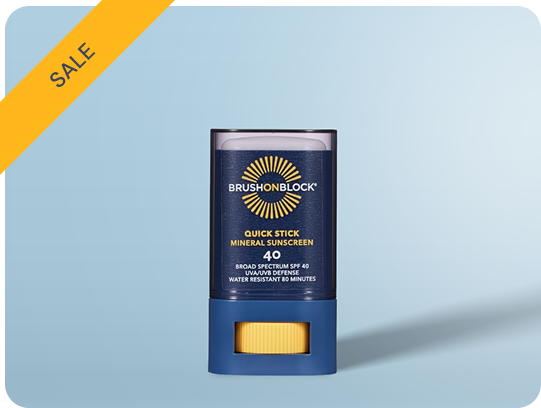
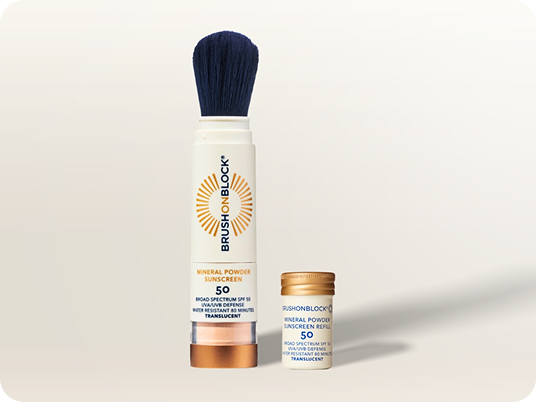
Brush On Block mineral powder sunscreens. Active ingredients: zinc oxide (SPF 30) and zinc oxide + titanium dioxide (SPF 50).
Why we chose mineral
When I was figuring out what to do for my daughter, and eventually what to build into a product, a few things became clear.
The first was daily wear confidence. Zinc oxide felt like the right foundation for something people would use every single day. For sensitive skin, reactive skin, skin that tends to push back, mineral just feels more appropriate for that kind of daily, ongoing use. A lot of people describe it the same way: they simply feel better knowing what's on their skin. That confidence matters because confidence supports consistency, and consistency is the whole point.
The second was predictability. Zinc oxide is stable and broad-spectrum on its own. We didn't need a complicated stack of filters to get there. Simple was the right approach for what we were building.
The third — and this is where the ingredient choice connects directly to how we design our products — was format. Mineral actives, particularly zinc oxide, work exceptionally well in a powder formula. That matters because powder is the format that makes reapplication over makeup realistic. You can't do that as easily with a liquid or cream, regardless of how portable it is. The products we've built are designed to go with you, and to actually get used again after the morning application, which is where most sun protection breaks down.

Designed for the reapplication you'll actually do — not just the morning application you intend to.
Does mineral sunscreen work?
Yes. SPF 30 blocks approximately 97% of UVB rays. SPF 50 blocks approximately 98%. When applied correctly and reapplied throughout the day, mineral sunscreen provides real, meaningful broad-spectrum protection.
Here's my honest take, after fifteen years of thinking about this: if you're choosing between mineral and chemical, I'd choose mineral. That's what I use, and it's what I sell. But if you're ever in a position where it's chemical sunscreen or nothing at all — wear the chemical.
As Dr. Hadley King, board-certified dermatologist and Clinical Instructor of Dermatology at Weill Medical College of Cornell University puts it: "Titanium dioxide and zinc oxide are two sunscreen ingredients that the FDA deems 'generally recognized as safe and effective.' These ingredients are not absorbed into the body" — and they block a wide range of UV wavelengths while remaining photostable, meaning they don't break down in sunlight the way some chemical filters do.
Sunscreen works when people actually use it. That's the whole argument, and I'd rather say it plainly than let perfect be the enemy of good.
What about white cast?
It's a fair concern, and it used to be a bigger one. Early mineral formulas left a visible white residue that was hard to ignore, especially on deeper skin tones. Formulation has improved significantly since then, and format matters too — how a product is designed to apply affects how it looks and feels on the skin. It's not a non-issue, but it's much less of one than it used to be. We cover this in more depth in our white cast post — link.
Who tends to prefer mineral
Mineral sunscreen is often the first choice for people with sensitive skin, acne-prone skin, rosacea-prone skin, reactive skin, post-procedure skin, and children. It's also a strong everyday choice for anyone who wants a stable, straightforward formula they can reach for daily without overthinking it.

Mineral sunscreen for every skin type, every day.
The reason it all comes back to
I didn't choose mineral to take a side in a debate. I chose it because it made sense for my family, and then I spent fifteen years building products around it that make sense for real daily life — easy enough to actually use, designed to apply and reapply, with an ingredient foundation people can feel good about.
The best sunscreen isn't the one with the loudest claims or the highest number on the label. It's the one you'll actually wear. For us, mineral is how we make that possible.
Quick Facts: Mineral Sunscreen
Mineral sunscreen uses zinc oxide, titanium dioxide, or a combination of both as its active UV filters. Zinc oxide and titanium dioxide are classified by the FDA as generally recognized as safe and effective (GRASE) for use as sunscreen active ingredients. They work by sitting on the skin's surface, where they scatter and absorb UV rays — they are not absorbed into the body. Zinc oxide provides broad-spectrum protection against both UVA and UVB rays on its own. Brush On Block uses non-nano zinc oxide across all formulations. Mineral sunscreen is suitable for daily use and is often preferred for sensitive, acne-prone, reactive, and children's skin. Brush On Block products are formulated with mineral actives and designed for both initial application and reapplication throughout the day.