

When my eldest daughter was a teenager, she was dealing with persistent breakouts we couldn’t get ahead of. We adjusted her routine, tried different products, did all the things you do. It took longer than it should have to identify the actual problem: her liquid foundation. The heavy emollients and thick formula were sitting on her skin and clogging it. Once we moved her to a powder mineral foundation with zinc oxide and titanium dioxide, her skin cleared up.
That experience taught me something I’ve carried into every product decision since. For acne-prone skin, what’s in a formula matters enormously, not just the active ingredients, but everything else that comes along with them. And once you understand that, the sunscreen question for acne-prone skin gets a lot clearer.
Why some sunscreens make acne-prone skin worse
For acne-prone skin, the most common sunscreen culprits are chemical UV filters and heavy emollients. These are ingredients that either get absorbed into skin that’s already reactive, or sit on top of it and add to congestion.
Chemical filters like avobenzone, oxybenzone, and octinoxate are absorbed into the skin to work. For skin that’s already inflamed or congested, that absorption process can trigger additional irritation. Some people with acne-prone skin react to specific chemical filters directly. Others react to the cumulative effect of a formula that’s simply too much for their skin to manage.
Heavy emollients and thickening agents, common in cream and lotion sunscreen formulas, can compound the problem by adding an occlusive layer that acne-prone skin doesn’t need. The result is a pattern most people with acne-prone skin recognize: you try to be responsible about sun protection, your skin breaks out, you stop wearing sunscreen.
The problem isn’t sunscreen. It’s the formula.

Zinc oxide and titanium dioxide sit on the skin's surface rather than being absorbed — a meaningful difference for acne-prone skin.
What mineral does differently
Mineral sunscreens use zinc oxide, titanium dioxide, or both as their active UV filters. They sit on the skin’s surface rather than being absorbed, which removes one of the primary irritation pathways for acne-prone skin. As Dr. Hadley King, board-certified dermatologist and Clinical Instructor of Dermatology at Weill Medical College of Cornell University notes, physical sunscreens are less likely to clog pores and irritate complexions, particularly for those with sensitive skin.
Zinc oxide in particular is anti-inflammatory and well-tolerated by skin that pushes back against most things. It’s not a treatment for acne, but it doesn’t aggravate it either, which for a daily-use product is exactly what you need.
For a deeper look at why we built the entire line around mineral actives, Why We Choose Mineral Sunscreen covers that fully.

Two formats, same foundation: mineral actives, no chemical filters, formulated without ingredients known to clog pores.
Choosing the right mineral formula for acne-prone skin
Within mineral sunscreens, formulas still vary. For acne-prone skin, what a product contains beyond the active ingredients matters too. Look for a short ingredient list, no chemical UV filters, and formulation without ingredients known to clog pores.
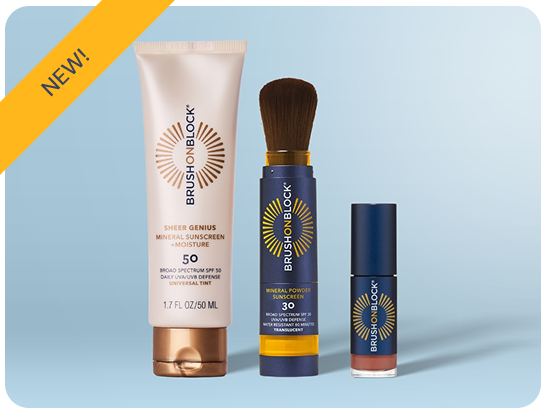
For reapplication throughout the day, our Translucent Mineral Powder Sunscreen SPF 30 is a particularly good fit for acne-prone skin. It contains no chemical UV filters and no liquid carriers or water-based preservatives, so there are fewer potential triggers. The powder format also absorbs surface oil as it’s applied, which helps manage excess sebum without adding weight to already congested skin. It applies in a controlled layer over whatever you’re already wearing, with no rubbing and no disruption.
For morning protection, a lightweight mineral moisturizer with SPF can simplify your routine without aggravating breakouts, provided it’s formulated without chemical filters and without heavy emollients. Our Sheer Genius Mineral Sunscreen + Moisture SPF 50 uses mineral actives with squalane and hyaluronic acid, ingredients chosen to hydrate without the occlusive weight that congests acne-prone skin. As with any new product, patch testing is worth doing if your skin is particularly reactive.
If you’ve been skipping sunscreen because of breakouts
Acne-prone skin still needs daily sun protection. UV exposure can slow skin’s healing process and aggravate post-breakout hyperpigmentation. Skipping sunscreen to avoid breakouts trades one problem for a more permanent one.
The answer is finding a formula your skin can tolerate, not giving up on the category. For most people with acne-prone skin, that means mineral actives, a lighter ingredient load, and nothing that asks your skin to absorb more than it needs to.
That’s the lesson my daughter’s skin taught me, and the one I’ve applied to every product we’ve made since. It wasn’t that the product was the problem. It was that we hadn’t found the right one yet.
If your skin is both acne-prone and sensitive, I Have Sensitive Skin. What Sunscreen Can I Actually Wear Every Day? covers the overlap between those two concerns in more detail.

It wasn't that sunscreen was the problem. It was finding the right one.
Quick Facts: Sunscreen for Acne-Prone Skin
- Acne-prone skin most commonly reacts to sunscreen due to chemical UV filters and heavy emollients.
- Mineral sunscreens use zinc oxide, titanium dioxide, or both, filters that sit on the skin’s surface rather than being absorbed.
- Zinc oxide is anti-inflammatory and formulated without ingredients known to clog pores.
- Powder mineral formats reduce ingredient load by eliminating liquid carriers and water-based preservatives.
- Brush On Block products contain no chemical UV filters.