

I was at a trade show a few years ago when a woman stopped at our booth and asked if I could help her. She knew she was supposed to wear sunscreen every day, but that wasn't the question. The question was whether there was anything her skin could tolerate. Everything she'd tried on her face made her feel itchy or like she was breaking out, and she'd stopped wearing it altogether.
She's not alone. It's one of the most common things I hear, and what I've learned after fifteen years of building sunscreen people want to wear is that most sunscreen reactions aren't random. They trace back to something specific. Once you understand what's causing the reaction, finding something that works becomes much more straightforward.
The active ingredient is what matters most
Sunscreens fall into two categories based on how they work.
Chemical sunscreens use UV filters — ingredients like oxybenzone, avobenzone, octocrylene, and octinoxate — that are absorbed into the skin, where they convert UV energy into heat. For sensitive and reactive skin, that's often where the trouble starts. These chemical filters are the most commonly identified cause of contact dermatitis from sunscreen.
For some people it's the absorption itself that triggers a reaction. For others, it's the photochemical activation — the process that occurs when those ingredients are hit by UV light — that causes the response. Sometimes it's both. Either way, the chemical filters are often at the root of it.

Zinc oxide only. No chemical filters, for people who need to trust what they’re wearing.
Mineral sunscreens use zinc oxide, titanium dioxide, or both. These filters sit on the skin's surface and scatter and absorb UV rays before they can penetrate. They don't need to be absorbed or activated to do their job, which is a meaningful difference for reactive skin.
Zinc oxide and titanium dioxide are not known to cause allergic contact dermatitis, and they're the active ingredients dermatologists consistently recommend when someone has reacted to chemical filters.
Within mineral sunscreens, formulas that use zinc oxide only tend to be particularly well suited to sensitive skin. Zinc oxide has a long history in sensitive skin care and is used in wound treatments and barrier products because of how gently it behaves on reactive skin.
If you want to understand more about why we built Brush On Block entirely around mineral actives, Why We Choose Mineral covers that in full.
Broad spectrum and SPF 30 or higher
Whatever sunscreen you choose for sensitive skin, it should be broad spectrum, meaning it protects against both UVA and UVB rays, and carry an SPF rating of 30 or higher.
SPF 30 filters approximately 97% of UVB rays and is appropriate for daily use across a wide range of conditions and activities. SPF 50 filters approximately 98% and is worth considering for extended time outdoors or higher-exposure days.
The right SPF is the one you'll wear every day and reapply consistently. For sensitive skin especially, a formula comfortable enough to use daily matters more than a higher number you reach for less often.
Format matters for sensitive skin
Once you've established that a sunscreen uses mineral actives and no chemical filters, format becomes the next practical consideration.
A mineral powder sunscreen is a strong fit for sensitive skin. It applies in a controlled layer using a brush, going on over whatever you're already wearing without disrupting it.
And because it's designed for daily reapplication — the kind you actually do — you're adding protection throughout the day without adding more product to skin that's managing sensitivity.

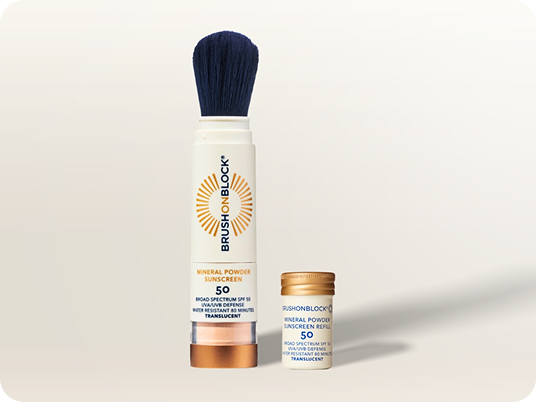
Brush On Block mineral powder sunscreen provides daily protection that works with sensitive skin, not against it.
What Brush On Block offers for sensitive skin
Our Translucent Mineral Powder Sunscreen SPF 30 uses zinc oxide as its only active ingredient, with no titanium dioxide or chemical filters. It's broad spectrum, water resistant for 80 minutes, and formulated with skin-support ingredients including niacinamide, hyaluronic acid, and Vitamin C.
It's designed for daily use and daily reapplication, which for sensitive skin means consistent protection without the disruption that can come from reapplying a liquid formula throughout the day.
For anyone who has given up on sunscreen because of how their skin reacts, the answer usually isn't to keep trying variations of what caused the reaction. It's to start from a different place: mineral actives, no chemical filters, and a format your skin can actually live with. I Have Sensitive Skin. What Sunscreen Can I Wear Every Day? goes deeper on the experience of reactive skin and what changes when you find something that works.
FAQ
What is the best type of sunscreen for sensitive skin?
Mineral sunscreens — those using zinc oxide, titanium dioxide, or both — are consistently recommended for sensitive and reactive skin. They sit on the skin's surface rather than being absorbed and are not known to cause allergic contact dermatitis.
Why does sunscreen make my skin itch or break out?
Most reactions trace back to chemical UV filters like oxybenzone, avobenzone, octocrylene, and octinoxate. These are absorbed into the skin and activated by UV light, which can trigger irritation in reactive skin.
Is zinc oxide good for sensitive skin?
Yes. Zinc oxide has a long history in sensitive skin care and is used in wound treatments and barrier products because of how gently it behaves on reactive skin.
What SPF should I use if I have sensitive skin?
SPF 30 or higher, broad spectrum. Daily use and reapplication every two hours of sun exposure matters more than the difference between SPF levels.
Can I reapply mineral powder sunscreen over my skincare without causing irritation?
Yes. Brush On Block mineral powder sunscreen is buffed onto skin in small circular motions, adding protection over what you're already wearing without disturbing it.
Quick Facts
- Chemical UV filters are the most common cause of sunscreen reactions in sensitive skin.
- Mineral sunscreens use zinc oxide and/or titanium dioxide, which sit on the skin's surface.
- Zinc oxide is especially well suited to sensitive and reactive skin.
- Look for broad spectrum protection with SPF 30 or higher.
- Brush On Block Translucent Mineral Powder Sunscreen SPF 30 uses zinc oxide only and is designed for daily use and reapplication.