

People ask me this a lot. Usually it comes from someone who's heard good things about mineral sunscreen, is thinking about making a switch, and wants an honest answer before they do. So here it is.
Both work. The difference is in how they work, who they work best for, and what tradeoffs come with each. Once you understand those differences, the choice tends to get a lot clearer.
How each one works
Chemical sunscreens use organic UV filters such as avobenzone, oxybenzone, octinoxate, octocrylene, and others that are absorbed into the skin. When UV rays hit, those filters undergo a chemical reaction that converts UV energy into heat, which then dissipates. They work from inside the skin, after absorption.
Mineral sunscreens use zinc oxide, titanium dioxide, or both. These filters sit on the skin's surface, where they scatter and absorb UV rays before they can penetrate. They don't need to be absorbed to do their job.
Both mechanisms provide real, tested broad-spectrum protection. SPF 30 filters approximately 97% of UVB rays regardless of whether it's mineral or chemical. SPF 50 filters approximately 98%. The number on the label reflects lab-tested protection for both types.
Where the meaningful differences are
The mechanism difference matters in a few specific ways.
Skin tolerance. Because chemical filters are absorbed into the skin and activated by UV light, they're more likely to cause reactions in sensitive or reactive skin. The most common sunscreen allergens are oxybenzone, avobenzone, and octocrylene, and they are all chemical filters. Zinc oxide and titanium dioxide are not known to cause allergic contact dermatitis. For people with sensitive skin, rosacea, eczema, or a history of sunscreen reactions, mineral is typically the more comfortable option. For skin that tolerates either without issue, this difference is less consequential.
Photostability. Some chemical filters, particularly avobenzone, break down when exposed to UV light. Manufacturers address this by pairing avobenzone with stabilizing ingredients, which adds complexity to the formula. Zinc oxide and titanium dioxide are inherently photostable, meaning they don't degrade in sunlight, so the protection level stays consistent throughout wear.

Mineral filters sit on the skin's surface. No absorption required.
Broad-spectrum coverage. Zinc oxide provides broad-spectrum protection against both UVA and UVB rays on its own, across a wide range of wavelengths. Chemical filters typically need to be combined, as no single chemical filter covers the full spectrum, which is why most chemical sunscreens contain several active ingredients working together. Neither approach is wrong, but zinc oxide's single-ingredient coverage is notable.
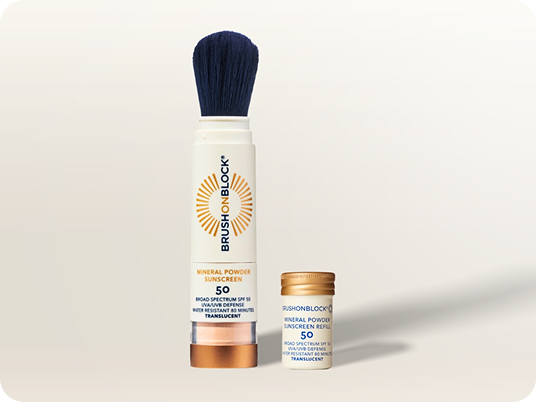
Application and reapplication. This one matters more than people realize. Mineral sunscreens, particularly in powder form, can be applied over makeup and reapplied throughout the day without disrupting what's already on your skin. That's harder to do with most liquid or cream chemical sunscreens, which require blending and getting your hands messy. For daily reapplication, which is where most sun protection routines fall apart, format flexibility is a real practical advantage of the mineral category.
What the FDA says
In 2021, the FDA reviewed 16 sunscreen active ingredients and designated only two — zinc oxide and titanium dioxide — as generally recognized as safe and effective, or GRASE. The remaining chemical filters were classified as needing more data, not because they were found to be unsafe, but because sufficient safety data hadn't been submitted to reach a definitive determination. The FDA has been clear that people should continue using sunscreen regardless of filter type.
This doesn't mean chemical sunscreens are unsafe. It means the safety classification for mineral actives is more settled. For people who want the most established safety profile, mineral is the clearer choice.

The best sunscreen is the one you'll actually wear and reapply.<./h6>
An honest bottom line
If you're choosing between a mineral sunscreen you'll wear every day and a chemical sunscreen you'll reach for inconsistently, wear the one you'll actually use. Any sunscreen is better than none.
That said, for daily facial use, mineral has real advantages: better tolerance for sensitive skin, photostability, single-ingredient broad-spectrum coverage with zinc oxide, and a format that makes reapplication realistic. Those aren't marketing claims. They're the reasons I built this brand around mineral actives fifteen years ago, starting with my own family's experience with chemical filter reactions.
If you want the full story on why mineral is the foundation of everything we make, Why We Choose Mineral covers that. And if you've been dealing with reactions to sunscreen specifically, Best Mineral Sunscreen for Sensitive Skin walks through what to look for.
FAQ
Is mineral sunscreen as effective as chemical sunscreen?
Yes. Both provide real, tested broad-spectrum protection. SPF 30 filters approximately 97% of UVB rays and SPF 50 filters approximately 98%, regardless of whether the formula is mineral or chemical. The difference is in the mechanism, the tolerance profile, and the practical tradeoffs, not in whether they work.
What is the difference between mineral and chemical sunscreen?
Chemical sunscreens use UV filters that are absorbed into the skin and convert UV energy into heat. Mineral sunscreens use zinc oxide, titanium dioxide, or both, which sit on the skin's surface and scatter and absorb UV rays before they penetrate. Both provide broad-spectrum protection. Mineral filters are not absorbed into the skin, are not known to cause allergic contact dermatitis, and are photostable. Chemical filters are more likely to cause reactions in sensitive skin and some require stabilizing ingredients because they break down in sunlight.
Why do dermatologists recommend mineral sunscreen for sensitive skin?
Because zinc oxide and titanium dioxide are not known to cause allergic contact dermatitis, while several common chemical filters such as oxybenzone, avobenzone, octocrylene are among the most common sunscreen allergens. For skin that's sensitive, reactive, or prone to contact dermatitis, removing the absorbed chemical filter from the equation removes the most likely trigger.
What does the FDA say about mineral versus chemical sunscreen?
In 2021, the FDA reviewed 16 sunscreen active ingredients and designated zinc oxide and titanium dioxide as generally recognized as safe and effective — GRASE. The remaining chemical filters were classified as needing more data. The FDA has stated that people should continue using sunscreen regardless of filter type. The GRASE designation for mineral actives reflects a more settled safety classification, not a finding that chemical sunscreens are unsafe.
Does mineral sunscreen leave a white cast?
It can, depending on the formula and format. Early mineral sunscreens were more prone to white cast, and it remains a concern with some formulations, particularly on deeper skin tones. Formulation has improved significantly, and format matters too. Brush On Block mineral powder sunscreens are translucent and formulated to buff on without leaving visible residue across a wide range of skin tones.
Can I switch from chemical to mineral sunscreen?
Yes, and for most people the transition is straightforward. Mineral sunscreens apply and feel differently than chemical ones, and the texture and finish vary by formula and format, so it may take a few tries to find the right fit. For anyone who has experienced reactions to chemical sunscreens, switching to mineral typically resolves the issue.
Quick Facts: Mineral vs. Chemical Sunscreen
Both mineral and chemical sunscreens provide real, tested broad-spectrum UV protection. Chemical sunscreens use UV filters that are absorbed into the skin and convert UV energy into heat. Mineral sunscreens use zinc oxide, titanium dioxide, or both, which sit on the skin's surface and do not require absorption to work. The FDA designates zinc oxide and titanium dioxide as generally recognized as safe and effective. Common chemical filters including oxybenzone and avobenzone are the most frequently identified allergens in sunscreen reactions. Zinc oxide provides broad-spectrum UVA and UVB coverage on its own and is photostable. Mineral powder sunscreen can be applied and reapplied over makeup throughout the day, an advantage for consistent daily protection.