



Frequently Asked Questions
Everything you want to know about mineral sunscreen, how Brush On Block products work, and how to make sun protection a habit that actually sticks.
Sunscreens protect your skin using one of two approaches. Chemical sunscreens use organic compounds that absorb UV energy and convert it to heat. Mineral sunscreens use inorganic mineral filters, specifically zinc oxide and titanium dioxide, that work on the skin's surface, reflecting and scattering UV rays and absorbing some as well.
Zinc oxide and titanium dioxide are the only two sunscreen active ingredients the FDA has found to be safe and effective for use in the United States. Both are broad-spectrum, meaning they protect against both UVA rays (associated with skin aging and long-term damage) and UVB rays (associated with sunburn).
All Brush On Block products use mineral-only UV actives. No oxybenzone, no octinoxate, no chemical filters, in any formula.
Yes, when applied with enough coverage. Many people use the Brush On Block powder as their primary morning SPF, applying it directly to clean skin before heading out. Others prefer a liquid formula for initial application and use the powder for reapplication throughout the day. Both approaches work.
The key is coverage: buff the powder across all exposed skin in a full, even layer rather than a light dusting. The powder deposits the minerals on the skin's surface, and consistent application is what delivers the protection you're expecting.
If you're new to powder sunscreen, try it as your morning step for a week. Most people find it faster and simpler than any liquid alternative they've used before.
Yes, and this is one of the main reasons people find us. The brush applies powder that doesn't disrupt foundation, concealer, or any other makeup product. You sweep it over your face mid-morning or after lunch, and your makeup stays exactly where it was.
This is what makes reapplication realistic for most people. Reapplying a liquid or cream sunscreen over makeup means starting your routine over from scratch. The powder removes that friction entirely, which means people actually do it.
Apply over a full face of makeup the same way you'd apply it over bare skin: brush across all exposed areas in an even layer. The powder sets slightly and leaves a natural, matte-to-satin finish depending on your skin type.
Dermatologists recommend reapplying sunscreen approximately every two hours during outdoor exposure, or immediately after swimming or heavy sweating. This isn't an arbitrary guideline. UV protection degrades with exposure time, sweat, touch, and environmental factors, and no sunscreen, regardless of SPF, maintains its initial level of protection indefinitely.
The SPF number on the label tells you how much UV radiation is filtered during a single, uninterrupted application under ideal conditions. It doesn't tell you how long that protection holds across a real day of living. Real-world protection depends as much on consistent reapplication as it does on SPF level.
Brush On Block products are designed specifically for this. The brush format makes reapplication fast enough to actually happen at a work desk, in a parking lot, or before an afternoon walk. That's not a secondary benefit. It's the whole reason the product exists.
SPF measures how much UV radiation a sunscreen filters relative to unprotected skin. SPF 30 filters approximately 97% of UV rays. SPF 50 filters approximately 98%. The difference is real but modest, about one percentage point of additional filtration.
Where the choice matters most is use case. SPF 50 provides a meaningful margin for extended outdoor time, high-altitude activity, beach or pool days, or anyone who wants the highest available protection as their baseline. SPF 30 is appropriate for everyday use and shorter outdoor exposure, especially for someone who applies and reapplies consistently.
It's worth knowing that the gap between SPF 30 and SPF 50 is much smaller than the gap between applying once and reapplying every two hours. Consistent reapplication at SPF 30 delivers better real-world protection than a single application of SPF 50 that isn't refreshed throughout the day.
Yes. Both provide broad-spectrum UVA and UVB protection when applied correctly and reapplied consistently. The active ingredients work differently, but the protective outcome for someone who actually wears the product is comparable.
We choose mineral-only actives because we believe zinc oxide is the right foundation for daily, long-term use. The FDA has reviewed both zinc oxide and titanium dioxide and found them safe and effective for use in sunscreen. Mineral actives are also generally well-tolerated, including by people whose skin reacts to chemical filters, which is one reason they're a good default for anyone building a consistent daily habit.
The most important variable in real-world protection isn't which active you use. It's whether you apply enough, and whether you reapply. A mineral sunscreen you actually wear every day, applied and reapplied consistently, outperforms a higher-SPF formula of any kind that you apply once and forget. That's the philosophy behind everything we make.
Yes, and it's one of the most common reasons people find us. Zinc oxide has a long history of safe use on sensitive, reactive, and easily irritated skin. It sits on the skin's surface rather than requiring absorption to work, and it's one of the gentlest active ingredients used in sunscreen.
Our formulas are also built with skin comfort in mind. The SPF 30 powder includes bisabolol, squalane, and hyaluronic acid, all of which support skin barrier comfort rather than stress it. The SPF 50 powder includes chamomile flower extract and bisabolol. Both are free of oxybenzone, octinoxate, and chemical UV actives.
If you've had reactions to sunscreen in the past, the most common culprits are chemical UV actives, fragrances, or emulsifiers. For people with reactive skin, the powder format removes several of the variables that most commonly cause problems, including liquid emulsions, preservative systems, and emulsifiers. Many people with eczema, rosacea, and acne-prone skin find the powder is the format they can wear consistently, day after day.
Yes. All Brush On Block products use mineral UV actives and are appropriate for children six months and older. The American Academy of Pediatrics recommends avoiding sunscreen on infants under six months; for that age group, shade and protective clothing are the recommended approach.
The BOB Kids line is specifically formulated for children, using only zinc oxide as the active ingredient across all formats: powder, balm, spray, and lotion. All BOB Kids products are water resistant to 80 minutes and made in the United States.
One thing that makes a real difference with kids is format and participation. Children who can choose the format that works for them are more likely to cooperate with the routine. The brush gives kids who want to participate a way to apply their own sunscreen, which tends to make the whole process easier. Visit the BOB Kids page to see all available formats.
Yes. Every Brush On Block formula uses mineral-only UV filters. No oxybenzone, no octinoxate, in any product in the line. Oxybenzone and octinoxate are the two chemical sunscreen actives most associated with coral reef harm and subject to bans in Hawaii, the U.S. Virgin Islands, and other marine-protected areas.
"Reef safe" is not a regulated term, so we say reef-friendly to be more accurate. What that means in practice: our formulas contain none of the ingredients that triggered reef-protection bans in the first place. Every product in the line meets those standards.
No sunscreen is truly waterproof, and the FDA no longer allows that claim on sunscreen labels because it's misleading. What the FDA does allow is water resistance ratings, which tell you how long a sunscreen maintains its protection during water or sweat exposure before reapplication is needed.
Most of our sunscreens are water resistant to 80 minutes, which is the highest rating the FDA allows. After swimming, towel drying, or heavy sweating, reapply. The 80-minute water resistance rating means the protection holds through that activity, not that it's unlimited.
Check individual product labels or product pages for specific water resistance ratings, as they vary by format.
Broad spectrum means a sunscreen protects against both UVA and UVB rays. Both cause real damage. UVB rays are the primary cause of sunburn. UVA rays penetrate more deeply into the skin and are associated with long-term photoaging, collagen breakdown, and a significant share of UV-related skin damage that happens without any visible burn.
A sunscreen that only protects against UVB, even at a high SPF, leaves UVA exposure unaddressed. Broad-spectrum protection means both are covered. All Brush On Block products are broad-spectrum.
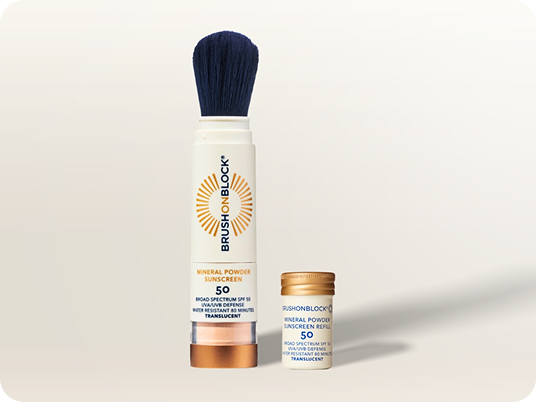
The Brush On Block powder brush is designed to last for years. When the powder runs out, you unscrew the bottom of the brush, remove the empty pod, and insert a new refill pod directly. No new brush needed.
Refill pods are aluminum and plastic-free, and each one carries its own expiration date and batch code. The system was designed this way intentionally. Most refillable sunscreen packaging still relies on plastic components; ours doesn't. The brush is a one-time investment, and the refill is what you replace.
Refills are available for the SPF 30 and SPF 50 powder sunscreens at brushonblock.com. The SPF 30 comes in Translucent and Touch of Tan; both shades have dedicated refill pods.
The sun care cycle is the framework behind how we think about complete daily sun protection: Protect, Reapply, Restore.
Protect is the morning application, the first layer of broad-spectrum defense. Reapply is the step most people skip, applying again approximately every two hours throughout the day, or after water and sweat. Restore is the after-sun step, supporting the skin barrier after a day of UV exposure, environmental stress, and the general wear of being outside.
Most people think about sun protection as a single morning step. The cycle reframes it as an all-day practice with a clear beginning, middle, and end. Read more about the full framework in our Sun Care Cycle post.
All Brush On Block sunscreens are manufactured in the United States in FDA-registered, inspected facilities. All formulas are FDA-compliant sunscreen drug products and dermatologist-tested.
Certifications:
- PETA-certified cruelty-free and vegan. We don't test finished products on animals, and none of our raw ingredient suppliers use animal testing.
- WBENC-certified women-owned business. Brush On Block was founded by Andrea Wetsel and is certified through the Women's Business Enterprise National Council.
- Reef-friendly by formulation. No oxybenzone, no octinoxate, no chemical UV actives in any formula.