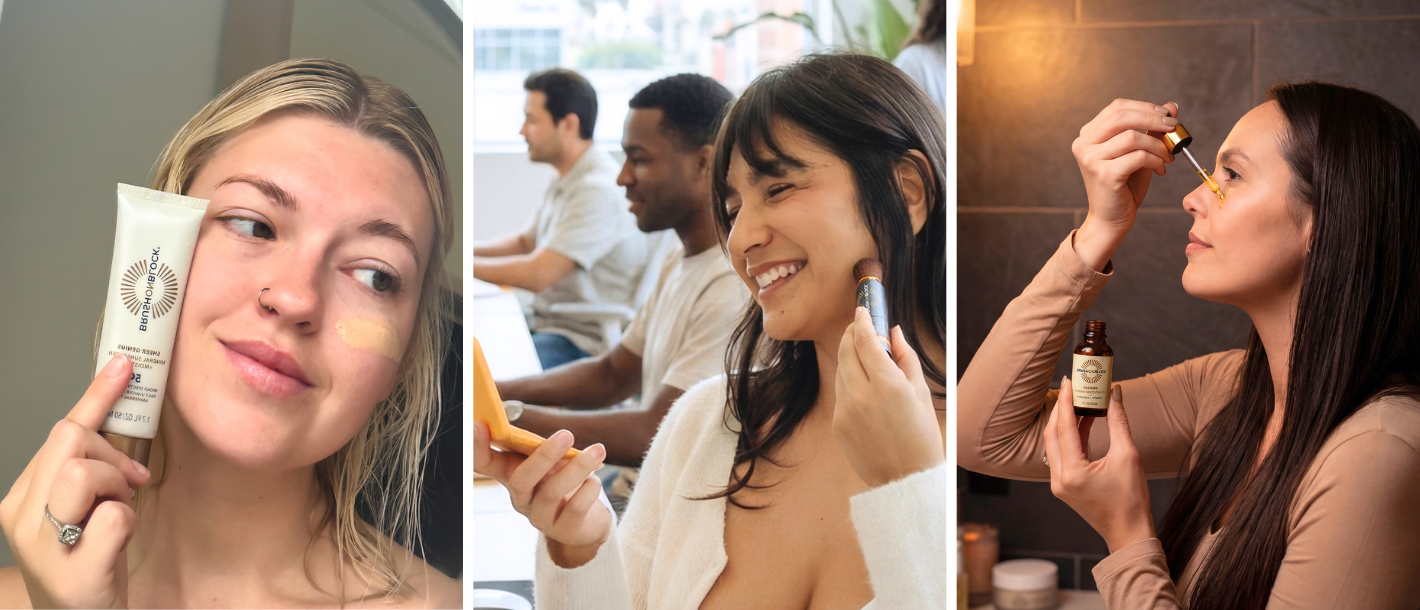


I've been making and using mineral sunscreen for fifteen years, and I still don't reach for the same product every day. Not because I can't decide, because the day decides for me.
Most mornings I start with Sheer Genius SPF 50. It goes on as part of my skincare routine, before anything else. It's a liquid mineral sunscreen, and it gives me a solid base layer of protection for whatever the day holds. If I'm heading into a normal workday, mostly indoors, some incidental outdoor time, I'll top up throughout the day with the powder. That's my everyday system, and it works because it fits how I actually move through an ordinary Tuesday.
But when the day is different, the product is different too.
A full day on the lake or a long hike means I'm reaching for SOL SPF 50 Spray-On Lotion for my body. It's water-resistant, covers a lot of skin quickly, and holds up through extended outdoor exposure. On the ski mountain, I want something precise and fast: QuickStick SPF 40 for my face, the powder to top up. Different conditions, different tools.
What I've noticed over the years is that what I'm doing matters at least as much as when I'm doing it. The format that works at 7am in front of a bathroom mirror is not necessarily the format that works at noon in a parking lot, or on a chairlift, or at the end of a long day outdoors when everyone still needs another round of protection before heading home.
Why one format can't do everything
Sunscreen works when you use it, and you use it when it fits the moment. That's the whole insight the brand was built on, and it's one I come back to constantly in my own routine.
A liquid sunscreen is excellent for morning application on clean skin. It spreads evenly, layers well under makeup, and gives you a uniform base. It is not, practically speaking, the easiest thing to apply over a full face of foundation at 1pm, or in a car between errands, or on your kids at a crowded trailhead when you've got one free hand.
A powder sunscreen is excellent for reapplication — over makeup, on the go, anywhere you don't have access to a sink. It is not designed to be your primary body coverage on a seven-hour outdoor day.
A spray-on lotion covers large surface areas fast, is water-resistant, and is ideal for extended outdoor activities. It requires rubbing in, which makes it less suited to a work bathroom touch-up.
None of these is the right answer to every situation. All of them are the right answer to the situation they were designed for.

Extended day outside. Different tool for the job.
The system underneath the products
We think about sun protection as a cycle: protect, reapply, restore. The Sun Care Cycle: Protect, Reapply, Restore is the full version of that thinking, but the short version is simply that protection isn't a single morning decision. It's something that has to hold up across a whole day, and across different kinds of days.
The formats exist to close the gaps. The morning base layer closes the gap between bare skin and the day ahead. The powder closes the gap between morning application and the afternoon when protection has faded and reapplication would otherwise be skipped. The spray closes the gap between a quick routine and a long day of real outdoor exposure.
When people ask us which sunscreen to use, the honest answer is often: it depends on your day. And for a lot of people, the right answer to a full week is more than one product. Not because we're trying to sell more things, but because their week actually contains more than one kind of sun exposure.
What a complete routine can look like
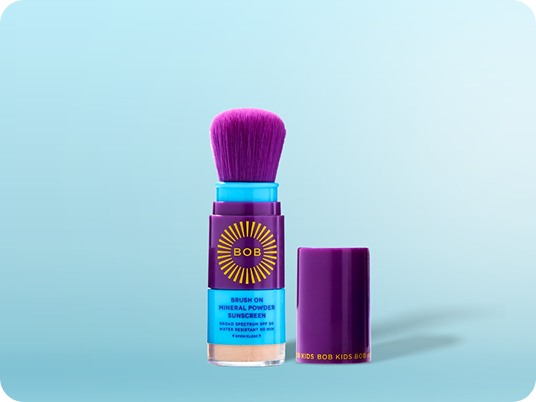
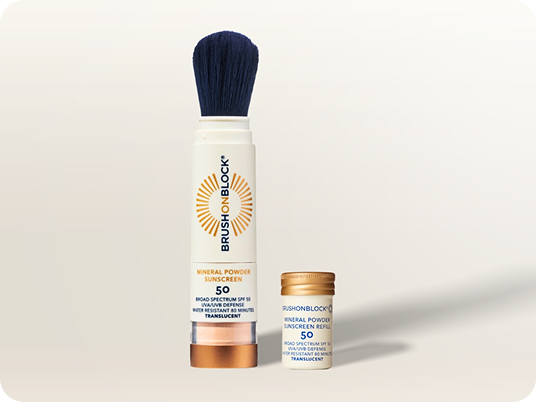
It doesn't have to be complicated. For most people, most of the time, two products cover the full range: a morning base — either Sheer Genius SPF 50 for a liquid mineral start, or the Brush On Block mineral powder sunscreen applied directly to skin before the day begins — and the powder in your bag for reapplication throughout the day. That handles the overwhelming majority of ordinary daily protection.
For days that are genuinely different — a long hike, a full day on the water, an afternoon at the park — adding SOL SPF 50 Spray-On Lotion for body coverage rounds out the system without overcomplicating it.
One more thing worth knowing: most dermatologists recommend SPF 30 for everyday use and SPF 50 for extended outdoor exposure. That's part of why the lineup is built the way it is — the powder comes in both SPF 30 and SPF 50 so you can match the level of protection to the day you're actually having, not just default to the highest number available.
The goal isn't a ten-step routine. It's having the right tool available when the moment comes, so that reapplication actually happens instead of getting skipped because it felt like too much. How to Reapply Sunscreen Throughout the Day has the practical side of that — when to do it, what to reach for, how to make it fit the day you're actually having.
The best sunscreen is the one you'll actually wear. Sometimes that means more than one.

In your bag, ready when you need it.
FAQ
Do I really need more than one sunscreen product?
Not necessarily, but it depends on your week. For someone who works indoors and spends limited time outside, a single mineral powder sunscreen applied and reapplied throughout the day may be enough. For someone who moves between a desk job and weekend outdoor activities, having a morning base layer and a reapplication product covers the full range more effectively than either one alone.
What's the difference between a morning sunscreen and a reapplication sunscreen?
A morning sunscreen is typically applied to clean skin as part of a skincare routine — a liquid or lotion that spreads evenly and layers well under makeup or on bare skin. A reapplication sunscreen needs to work over whatever is already on your face mid-day, which is why powder format is particularly well suited to it. The two jobs are different, and the best format for each is different too.
How do I know which sunscreen format is right for my activity?
Think about what the day actually requires. For ordinary days with incidental outdoor exposure, a morning base layer and powder reapplication covers it. For extended outdoor time (beach, hiking, water activities) a water-resistant spray or lotion that covers large surface areas quickly is the more practical choice for the body. For targeted on-the-go coverage in active conditions like skiing or a day out, a stick format works well. The format should match the moment.
What SPF level should I use?
Most dermatologists recommend SPF 30 for everyday use and SPF 50 for extended outdoor exposure. For a normal workday with incidental sun exposure, SPF 30 provides strong, reliable protection. For a full day outside (at the beach, on a hike, on the water) SPF 50 is the better choice. The right number depends on how much sun exposure your day actually involves.
Can I use just the powder as my only sunscreen?
Yes, Brush On Block mineral powder sunscreens are fully tested standalone sunscreens with broad-spectrum SPF 30 and SPF 50 protection and 80-minute water resistance. Many people use the powder as their primary and only sunscreen, particularly for daily use. If you're spending an extended day outdoors and covering large areas of skin, SOL SPF 50 Spray-On Lotion adds water-resistant body coverage that rounds out the routine.
Is layering multiple sunscreens safe?
Yes. Using a liquid sunscreen in the morning and a powder for reapplication throughout the day is a common and well-supported approach. The two formats complement each other. The liquid provides an even base layer, and the powder maintains protection across the day without requiring you to start over. You don't add the SPF numbers together. Think of the reapplication as refreshing protection, not doubling it.
Quick Facts: Why One Sunscreen Is Rarely Enough for Real Life
Most people apply one sunscreen product in the morning and don't reapply. Dermatologists recommend reapplying every two hours of sun exposure. Different activities and moments in the day benefit from different sunscreen formats — a liquid for morning base coverage, a powder for midday reapplication over makeup, a water-resistant spray or lotion for extended body coverage outdoors. Most dermatologists recommend SPF 30 for everyday use and SPF 50 for extended outdoor exposure. Brush On Block offers mineral sunscreen in multiple formats designed to work together across a full day: Sheer Genius SPF 50 liquid mineral sunscreen, Mineral Powder Sunscreen in SPF 30 and SPF 50, SOL SPF 50 Spray-On Lotion, and QuickStick SPF 40. Using more than one format is not about buying more products it's about closing the gaps where protection fades and reapplication gets skipped.