

If you’re someone taking the time to read this blog, then I’m sure you’ve heard: the FDA has approved the first new sunscreen active ingredient in over 25 years. The last approval was the chemical filter avobenzone, which came in 1997, long before I had learned to read sunscreen labels. But now bemotrizinol, or BEMT, is on store shelves, and despite it also being a chemical filter, I’m thrilled. I know how that sounds coming from a mineral sunscreen company, but anything that gets more people to wear sunscreen is good news to me.
Since the FDA announced the approval of BEMT, I’ve had more conversations about sunscreen than I have in a long time. Friends, customers and people I’ve just met want to know what I think about it. Any time sunscreen makes the news for a good reason, more people start paying attention to it.
Bemotrizinol (BEMT) is new to US shelves. A few brands have already launched BEMT sunscreens here, including one of the biggest names in the drugstore aisle, and you’ll be seeing more soon. If you wear mineral sunscreen, you may be wondering whether you should switch. I’m still a proponent of mineral only, and that won’t change for my family. But I also believe that any sunscreen is better than no sunscreen, and everyone should find a formula that works for their skin and their routine.
What is bemotrizinol?
BEMT (also sold as Tinosorb S or Parsol Shield) is a chemical UV filter that provides both UVA and UVB protection and holds up well in sunlight. The FDA also found that very little of it is absorbed through the skin and into the body.
BEMT has been used in Europe, Canada, Asia and Australia for more than twenty years. The US was slower to approve because sunscreen is regulated here as an over-the-counter drug, and adding a new active ingredient takes years of safety review. The FDA has now approved it for adults and children 6 months and older.

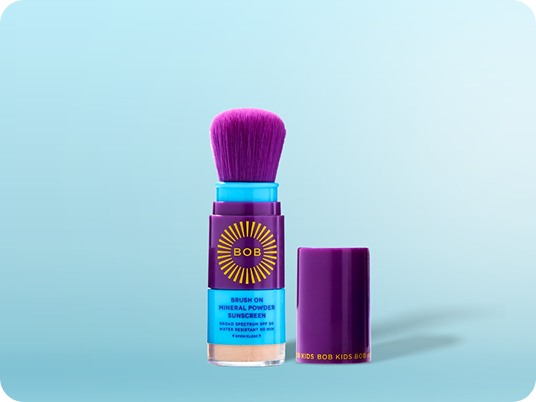
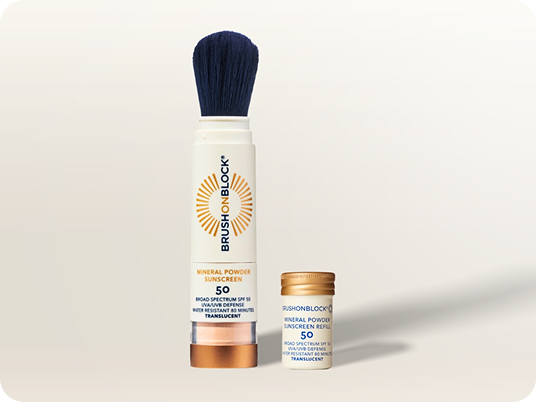
Brush On Block SPF 30 uses zinc oxide as its only active sunscreen ingredient and buffs in sheer.
How does it compare to zinc oxide?
Both provide broad-spectrum protection. For most people choosing a sunscreen, the more noticeable differences will be how the formula feels and what other ingredients are in it.
BEMT’s big appeal is that it wears light and invisible. Mineral sunscreen has a reputation for white cast, and some of that reputation is earned, but mineral formulas have come a long way in the fifteen years I’ve been making them. Our Translucent SPF 30 powder is zinc oxide only and buffs in sheer, which is why so many people wear it over their makeup.
Many BEMT sunscreens pair it with other chemical filters, so if you want mineral only, read the active ingredients list. Zinc oxide is often a good option for sensitive skin. I started Brush On Block because my daughter Grace had reactions to chemical sunscreen when she was little. Fifteen years later, I still regularly talk with customers who’ve found that chemical sunscreens don’t work for their sensitive skin.
The part no filter changes
After fifteen years of talking with customers, the reason I hear most often for skipping sunscreen is how it feels on their skin. A filter that feels better can help with that.
But even the best sunscreen only protects you while it’s on your skin. Sun exposure isn’t limited to a beach day. It’s the walk to your car at lunch, the school pickup line, the drive with the window down. Reapplying every two hours, or more often if you’re swimming or sweating, is where most of us fall off, and it usually comes down to hassle. Lotion over makeup, at your desk, with no sink nearby, is a lot to ask.
That’s the problem we built Brush On Block to solve. Our SPF 30 Mineral Powder is non-nano zinc oxide, and it is water resistant for 80 minutes. It buffs on over makeup in about 15 seconds per area, goes in a bag or pocket, and you can use it on your scalp and hairline too. What I hear from customers more than anything else is how easy it is to reapply, and because it’s easy, they do it. The brush lives in a purse, a golf bag or a school backpack and comes out wherever they are, at a desk, in the carpool line or at the turn on the golf course.

Keep sunscreen close enough to reapply wherever the day takes you.
So, should you switch?
It depends on what you need. If you’ve never found a sunscreen you like wearing and you’re comfortable with chemical filters, a BEMT formula is worth trying. If mineral works for your skin, this launch is no reason to stop. Zinc oxide protects you the same way it did before BEMT arrived, and it’s still one of the best options for sensitive skin.
You also don’t have to choose. Plenty of people wear a morning sunscreen they love and keep a mineral powder in their bag for touch-ups. I’m glad sunscreen is getting this much attention, and I hope all these new conversations turn into more people wearing it every day. Whatever formula you choose, put it on in the morning and keep it close enough to reapply.
FAQ
Is bemotrizinol a mineral sunscreen?
No. Bemotrizinol is a chemical UV filter. The two mineral filters used in US sunscreens are zinc oxide and titanium dioxide.
Is bemotrizinol safe?
The FDA found it safe and effective for adults and children 6 months and older, with low absorption into the body. It has been used in other countries for more than twenty years.
Can I use mineral powder over a BEMT sunscreen?
Yes. Powder over your morning sunscreen is an easy way to reapply during the day without disturbing makeup.
What’s the difference between bemotrizinol and zinc oxide?
Bemotrizinol is a chemical UV filter, while zinc oxide is a mineral UV filter. Both provide broad-spectrum protection, but they differ in how they’re formulated and how the finished sunscreen can look and feel on skin.
Is bemotrizinol new?
Only in the US. It has been used in sunscreens in Europe, Canada, Asia and Australia for more than twenty years, and it’s the first new sunscreen active the FDA has added since 1997.
Does Brush On Block use bemotrizinol?
No. Every Brush On Block sunscreen is all mineral, with no chemical filters.